What to study (and what not to) in a systems engineering degree for 2032: a 9-semester proposal
Someone who starts a computer systems engineering degree in 2027 will, if all goes well, graduate between 2031 and 2032. By then, much of what today fills entire semesters will be done by an AI agent in minutes. This article asks a practical question, aimed at students, teachers and curriculum designers: what is worth learning in a systems engineering degree so that those nine semesters still pay off when the student graduates?
In the article on UNAM we reviewed a single course in an 8-semester bachelor's program. Here we go further, in three steps:
- We use a real curriculum as our example: the Computer Systems Engineering degree of Mexico's National Technological Institute (TecNM), the country's largest network of public engineering schools, with its specialization in Data Science and Intelligent Applications.
- We review, with the same rigor, a reform proposal we wrote ourselves a few weeks ago: the Proposal to transform Computer Systems Engineering in Mexico for the AI era (2027-2035). It gets important things right, and it also has mistakes worth saying out loud.
- We close with an ideal 9-semester proposal. It does not follow a fixed number of courses per semester or of credits: each semester carries what it needs, no more and no less.
What is changing in the profession, and what is not
A curriculum should not be designed around what AI might do someday, nor around what it did three years ago. This is what has been measured:
| What | Data | Source |
|---|---|---|
| It completes ever longer tasks | The length of tasks frontier models complete with 50% success has doubled roughly every seven months since 2019 | METR, Kwa et al. (2025) |
| It already writes a visible share of software | 18.7% of pull requests merged on GitHub in September 2026 were signed by AI agents | Our own data, verification debt article |
| It does not always speed things up | Experienced developers took 19% longer with AI on their own repositories, while believing they were faster | METR, randomized trial (2025) |
| Without guardrails, it harms learning | Students who practiced with unrestricted AI scored 17% lower on the exam than those who never used it | Bastani et al., PNAS (2025) |
| The market hires fewer newcomers | Employment of 22-to-25-year-olds in the occupations most exposed to AI fell 19% below that of their less exposed peers | Brynjolfsson, Chandar and Chen (2026) |
The reading is uncomfortable but clear. Writing an implementation from a description no longer sets an engineer apart. What does is everything around that implementation: understanding the problem and the people who have it, specifying it without ambiguity, choosing an architecture under real constraints of cost, law and existing systems, verifying independently, running it in production and answering for the result. And because the market hires fewer newcomers, graduates need to arrive with that judgment already formed, not expect to acquire it in their first job (the problem we called the broken pipeline).
Nobody knows what AI will be able to do in 2032. So it makes sense to design for several scenarios at once:
| Scenario in 2032 | What AI does | What graduates need to be able to do |
|---|---|---|
| Copilot | It helps, but much of the work is still manual | Program well, design, and use AI efficiently |
| Supervised executor | Agents complete multi-day projects under supervision | Specify, split work, verify and secure |
| Highly autonomous | Nearly all routine implementation is automated | Define problems, govern systems, audit and answer for them |
The proposal in this article tries to work in all three. The way to do that is to bet on what holds value in every one: fundamentals, verification, domain knowledge and accountability. In the most autonomous scenario those four are worth more, not less: the more a machine produces, the more it matters to have someone who can tell when it got things wrong.
The current curriculum: a 2010 structure with a 2025 specialization
The TecNM curriculum we use as an example has 9 semesters, 260 credits and 51 courses, plus a professional residency, community service and complementary activities. The common core dates from 2010; the Data Science and Intelligent Applications specialization was added in 2025 with five courses: Introduction to Data Science, Data Engineering and Big Data, Data Analytics, Machine Learning for Data Science, and Application Development for Data Science.
It has a lot of value. The mathematical base is solid (four calculus courses, linear algebra, probability, discrete mathematics), it keeps the theory that explains computing (languages and automata, logic and functional programming), and it ends with a full professional residency, one of the best features of the TecNM model.
But read with 2026 eyes, the curriculum shows five problems:
- AI arrives at the end. Artificial Intelligence sits in the 9th semester and the specialization in the 7th, 8th and 9th. Students spend eight semesters without understanding how the tool they already use every day works.
- There is not a single security course. Out of 51. In a world where an agent with permissions can delete a database or leak personal data, this is the most serious gap.
- There is no testing or verification course. Students learn to build, not to show that what they built works. That is exactly what AI makes scarce.
- The load is badly distributed. Networking takes four courses (Telecommunications, Networks, Switching and Routing, Network Administration) and databases three. Meanwhile statistics gets a single course, and without statistics you cannot evaluate a model.
- Courses are isolated. There are workshops, but no project that integrates each semester's learning. The first time everything comes together is the residency.
Our first proposal, reviewed with the same rigor
Our 2027-2035 proposal started from a premise we keep: stop training engineers whose main skill is producing code, and train engineers who can design, direct, verify, protect and evolve systems, using human and artificial intelligence. Reviewing it carefully, we found strengths we keep and mistakes we correct.
What it got right, and stays
- Two competencies assessed separately. The independent one (solving, debugging and explaining without AI) and the augmented one (producing more with AI, while justifying and verifying). It is the most important idea in the document.
- Assessment through oral defense and seeded faults. The instructor introduces an unknown defect and the student diagnoses it. A language model cannot do that for the student during the defense.
- Splitting content into three layers with different review cycles: the scientific core every 4-5 years, technology competencies every year, tools every quarter.
- A mandatory project every semester, growing in complexity.
- Demonstrating command of code without assistance in the first semester.
What it got wrong, and is corrected
1. It contradicted its own rule. Section 8 said there should be no new course for every new tool, and then the curriculum proposed Prompt engineering, Vector databases, LLM and RAG application lab, LLM engineering, Agentic systems and orchestration, Multi-agent system design, Autonomous systems and human oversight, MLOps and LLMOps and Inference optimization. In all, 13 of its 52 courses revolved around language models, with 2025 names. By 2032 several will have been renamed or turned into a unit of another course: a "prompt" is already, in practice, a written specification, and vector databases are already an index inside general-purpose databases.
2. It cut what AI makes more valuable. It reduced four calculus courses to one, yet in the 5th semester it required Deep learning and transformers, which needs multivariable calculus. It dropped Operations Research, Numerical Methods and Simulation, when optimization is the heart of machine learning. And it left out the theory of computation, which is the basis for reasoning about what a program can decide and for formal verification.
3. It lacked what working with AI demands most. It had no course on software testing as a discipline, only "AI testing". It did not teach reading and maintaining other people's code until the 8th semester, even though that is most real-world work and what an agent generating thousands of lines demands most. It asked for specification skills, but no course taught them. And it removed Accounting, Business Culture and Management without replacing them, when business knowledge is exactly what AI does not bring.
4. It brought generative AI in too early. Prompt engineering in the 2nd semester and Introduction to intelligent systems in the 1st. The evidence on learning (Bastani et al., 2025; Prather et al., 2024) points the other way: build judgment first, delegate later.
5. Statistics was still a single course. Evaluating an AI system is statistics: an evaluation with 50 cases and no confidence interval proves nothing.
The lesson for us was simple: it is easy to write a proposal that sounds like 2026; the hard part is writing one that still works in 2032.
Four tests for deciding what goes into the curriculum
To avoid repeating the mistake, every course in the final proposal had to pass four tests:
| Test | Question | If it fails |
|---|---|---|
| Durability | Will it still be taught under the same name in 2035? If the name contains an acronym that did not exist five years ago, probably not | It goes to the lab, not the curriculum |
| Verification | Does it increase the ability to judge whether a system is correct, secure or worth what it costs? | It is reduced or merged |
| Non-delegable | Does it build something AI cannot do for the person: understand a domain, decide, take responsibility? | It loses priority |
| Load | Does it duplicate something already in another course? | It is merged |
With those tests, the content sorts itself out:
| Durable: belongs in the curriculum | Ages fast: belongs in labs reviewed every quarter |
|---|---|
| Mathematics, inferential statistics and optimization | Model and vendor brands |
| Algorithms and complexity | Agent and orchestration frameworks |
| Operating systems, networks, distributed systems and database internals | Specific vector databases |
| Theory of computation and logic | "Prompting techniques" |
| Specification, design, testing and verification | Consoles and services of a specific cloud |
| Security and threat modeling | This year's deployment formats and tools |
| How models work and fail, from first principles | Trendy benchmarks |
| Technical communication, business knowledge and legal accountability | The code editor or assistant of the moment |
Nothing in the right-hand column is useless: students must use it, a lot. But it is learned in labs and projects that are updated without reforming the curriculum, because a formal curriculum in Mexico takes years to change. This one has been in force since 2010.
What happens to the 51 courses of the current curriculum
The most surprising result of the analysis is that the current curriculum does not need to be torn down, only reorganized. Only one course is removed entirely.
| Outcome | Current courses | Why |
|---|---|---|
| Kept, updated | Programming Fundamentals, Object-Oriented Programming and Data Structures (become two), Discrete Mathematics, Linear Algebra, Computer Architecture, Operating Systems (absorbs its workshop) | They are the core. How they are taught and assessed changes |
| Merged | Differential + Integral Calculus → Calculus. Vector Calculus + Numerical Methods + Operations Research → Multivariable calculus and optimization. The four networking courses → Computer networks. The three database courses → Databases (administration moves to Operations). Languages and Automata I and II → Theory of computation. Logic and Functional Programming → Programming languages | Same substance, less repetition |
| Transformed | Software Engineering Fundamentals + Software Engineering → Software design and architecture and Software testing and verification. Accounting + Business Culture + Management Workshop → Business processes and domain modeling. Project Management → Software management and economics. Research Fundamentals + Research Workshops I and II → Technical communication and specification and Applied research. Ethics Workshop + Sustainable Development → Technology law, privacy and governance | The goal still holds; the content does not |
| Grows | Probability and Statistics → Probability and Inferential statistics and experimental design. Simulation is split between the latter and Operations | Evaluating means measuring |
| Moves earlier and expands | Artificial Intelligence and the five specialization courses → Machine learning, Data engineering, Foundation models, AI systems engineering and Evaluation and assurance of AI systems, in the 5th and 6th semesters | AI stops being the end of the degree |
| Distributed | Web Programming goes into the integrative workshops; Advanced Programming Topics, into Operating Systems, Distributed Systems and the workshops | The web is the medium, not the subject |
| Move to a track | General Physics, Electrical Principles, Programmable Systems, Interface Languages and Differential Equations → Embedded systems and robotics. Computer Graphics → Intelligent systems (vision) | Valuable for those heading into hardware, not for everyone |
| Removed | Chemistry | It serves no track |
And nine courses enter that do not exist in the current curriculum: Technical communication and specification, Inferential statistics, Software testing and verification, Human-computer interaction, Software security, Distributed systems and cloud, Operations and reliability, Evaluation and assurance of AI systems, and Systems auditing. On top of that come the integrative workshops of each semester.
The proposal: a systems engineering degree for 2032
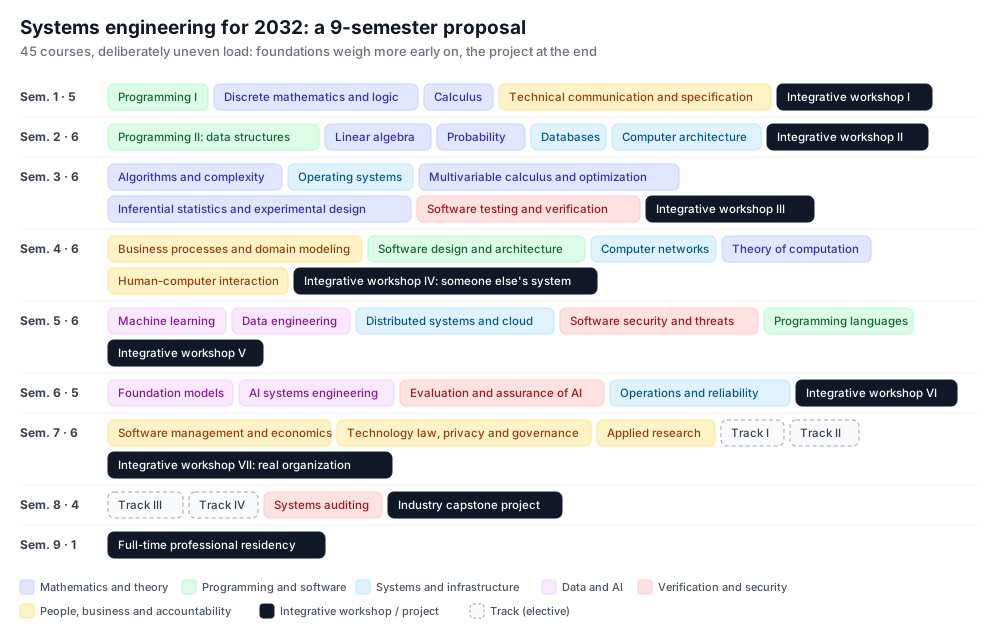
Nine semesters, like most of these engineering degrees in Mexico. The load is deliberately uneven: early semesters carry more courses because they build the foundation; later ones carry fewer because the project grows until it takes up almost all the time. The last semester is a full residency.
Two threads run through the whole degree and explain the order:
- The verification thread: tests from the 2nd semester, a testing course in the 3rd, security in the 5th, AI evaluation and operations in the 6th, auditing in the 8th. Each semester verifies something larger than the last.
- The AI ladder: what students may delegate grows with their judgment.
| Semesters | Permitted AI use | Purpose |
|---|---|---|
| 1 and 2 | A tutor that explains, does not generate code | Build one's own judgment |
| 3 and 4 | Generates code, with mandatory verification and a log of what was accepted and why | Learn to specify and verify someone else's work |
| 5 and 6 | Agents with scoped permissions | Design the limits of what an agent may do |
| 7 to 9 | Directing agents as a team and auditing their work | The real professional role |
1st semester — Thinking and programming without a net (5 courses)
| Course | What it builds |
|---|---|
| Programming I | Reading, tracing, writing and testing small programs, without code-generating assistants |
| Discrete mathematics and logic | Sets, relations, induction and logic: the language of specifications |
| Calculus | Single-variable, in one intensive semester, focused on change and approximation |
| Technical communication and specification | Reading documentation, writing unambiguous requirements and explaining a decision in writing. What we now call a prompt is, most of the time, a poorly written specification |
| Integrative workshop I | The terminal, version control and a command-line program defended without assistance |
2nd semester — Structures, data and the machine (6 courses)
| Course | What it builds |
|---|---|
| Programming II: data structures | Invariants and property-based tests from the very first structure |
| Linear algebra | Vectors, matrices and decompositions: the basis of every model |
| Probability | Random variables, distributions and expectation |
| Databases | The relational model, SQL, transactions and indexes: how a business's source of truth is stored and queried |
| Computer architecture | How the machine executes: memory, caches and parallelism |
| Integrative workshop II | An application with a database and tests written by the student |
3rd semester — Algorithms, systems and first verification (6 courses)
| Course | What it builds |
|---|---|
| Algorithms and complexity | Judging whether a solution scales, no matter who wrote it |
| Operating systems | Processes, memory, files and concurrency |
| Multivariable calculus and optimization | Gradients, the chain rule and linear programming: how a model learns and how resources are allocated |
| Inferential statistics and experimental design | Intervals, hypothesis tests and sample size. Without them you cannot evaluate a model or demonstrate an improvement |
| Software testing and verification | Unit, property-based and mutation testing, and contracts. The first course where AI generates and the student verifies |
| Integrative workshop III | A web service with an API, tests and deployment, with code generated by AI and verified by the student |
4th semester — Software for people and organizations (6 courses)
| Course | What it builds |
|---|---|
| Business processes and domain modeling | How an organization operates (accounting, inventory, collections), how to interview the people who have the problem and how to model it. It is the context AI does not bring |
| Software design and architecture | Modules, boundaries, dependencies and recorded decisions |
| Computer networks | From the link layer to HTTP, DNS and TLS, in a single course |
| Theory of computation | Automata, grammars and computability: what a program, or a model, can and cannot decide |
| Human-computer interaction | Human-centered design, accessibility and user testing |
| Integrative workshop IV | Extending and fixing an existing system of thousands of lines the student did not write. This is normal in industry and what working with agents demands most |
5th semester — Data, learning and security (6 courses)
| Course | What it builds |
|---|---|
| Machine learning | Classical models, training, overfitting and rigorous evaluation |
| Data engineering | Data pipelines, quality, lineage and governance |
| Distributed systems and cloud | Consistency, partial failures, scaling and infrastructure as code, as principles rather than one vendor's services |
| Software security and threat modeling | Threats, identity, secrets and the most common application vulnerabilities |
| Programming languages | Paradigms (functional and logic), types as a verification tool and how a program is translated and executed |
| Integrative workshop V | A product with a machine learning model evaluated on real data, with its threat model |
6th semester — AI systems in production (5 courses)
| Course | What it builds |
|---|---|
| Foundation models: how they work and how they fail | Deep networks, transformers, information retrieval and multimodality from first principles; hallucination, bias and limits |
| AI systems engineering | Tools, permissions, memory, agent orchestration, cost and latency. Its lab is reviewed every quarter: this is where the frameworks of the moment live |
| Evaluation and assurance of AI systems | Evaluation sets, regression testing, adversarial testing and prompt injection |
| Operations and reliability | Observability, service objectives, incidents, postmortems, deployment and rollback |
| Integrative workshop VI | Running an AI service with real metrics, a cost budget and a simulated incident |
Nearly all of the 13 language-model courses from our first proposal fit here as units and labs; AI security and governance move to Software security (5th) and Technology law, privacy and governance (7th). What lasts is in the curriculum; what ages, in the lab.
7th semester — Answering for what you build (6 courses)
| Course | What it builds |
|---|---|
| Software management and economics | Estimation, total cost (including cloud and inference), product and contracts |
| Technology law, privacy and governance | Personal data protection, intellectual property of generated code, liability, AI regulation and the environmental cost of computing |
| Applied research | Framing a question, designing an experiment and reporting honestly, including what did not work |
| Track I | First specialization elective |
| Track II | Second specialization elective |
| Integrative workshop VII | A project with a real organization, defending technical, economic and ethical decisions before it |
8th semester — Auditing and specializing (4 courses)
| Course | What it builds |
|---|---|
| Track III | Third elective |
| Track IV | Fourth elective |
| Systems auditing | Auditing a system you did not build: code, security, data, costs and compliance, with an evidence-based report. It closes the verification thread |
| Industry capstone project | A pilot delivered to an organization, with evidence of value and operational controls |
Community service, here or earlier, is directed toward specifying and auditing real systems under supervision.
9th semester — Professional residency (1 course)
A full-time residency in an organization, with a running system defended before external specialists. The verifiable portfolio (specifications, tests, recorded decisions, AI usage logs, audit reports) is the deliverable of the whole degree, not one more course.
In total, 45 courses versus the current 51, with more integrated practice and no extra time.
Six tracks instead of one specialization
Instead of a single specialization, four electives in one of six tracks. All share the same core, and several respond to concrete needs in Mexico:
| Track | Courses | Why in Mexico |
|---|---|---|
| Intelligent systems | Advanced deep learning; model adaptation and fine-tuning; information retrieval and search; vision and speech | Building our own solutions, not just consuming foreign models |
| Platforms and cloud | Containers and orchestration; infrastructure as code; platform engineering; cloud cost management | Every company that adopts AI needs to run it at a sustainable cost |
| Cybersecurity | Offensive security in authorized environments; defense and incident response; applied cryptography; security of agents and models | The attack surface grows with every agent that has permissions |
| Embedded systems and robotics | Physics and electronics for computing; embedded systems; control (where differential equations come in); edge perception | Manufacturing and nearshoring call for software that touches the physical world |
| Modernizing existing systems | Legacy platforms (mainframe and similar); data migration; enterprise architecture; AI-assisted modernization with equivalence verification | Banking, government and manufacturing depend on decades-old systems someone has to transform without breaking |
| Data for decision-making | Analytics and visualization; time series and forecasting; applied operations research; data governance | Logistics, retail and the public sector increasingly decide with data |
How students are assessed
We keep the heart of our first proposal, two competencies assessed separately, and add what it was missing: the balance shifts over the degree. Early on, what the student can do alone weighs more; at the end, what they can direct and defend.
| Stage | Without AI: individual fundamentals | With AI: project | Defense and technical review | Documentation and collaboration |
|---|---|---|---|---|
| Semesters 1 and 2 | 50% | 20% | 20% | 10% |
| Semesters 3 to 6 | 30% | 35% | 25% | 10% |
| Semesters 7 to 9 | 15% | 40% | 30% | 15% |
The weights are indicative. What does not change is the kind of evidence:
- Oral defense: each student explains any part of what they submit.
- Seeded-defect audit: students receive AI-generated code with known bugs, and we measure how many they find. It is graded automatically, so it scales to large groups.
- A fault introduced during the assessment: the instructor breaks something and the student diagnoses it.
- AI usage log: what was asked, what was accepted, what was rejected and why.
A working CRUD app no longer proves anything. A specification, tests that catch seeded defects and a confident defense do.
How it stays current
The three-layer idea from our first proposal survives intact, and it is what makes everything else possible:
| Layer | What it contains | Reviewed |
|---|---|---|
| Core | The courses in this proposal | Every 4 or 5 years, with continuous monitoring |
| Competencies | The learning outcomes of each course | Every year |
| Labs | Specific models, frameworks, cloud services, assistants and agents | Every quarter, without depending on a vendor |
When a new generation of models arrives, the university does not need a new course: it updates the AI systems engineering lab and the integrative workshops.
Why 9 semesters and not fewer?
If AI writes the code, it is tempting to shorten the degree. We do not recommend it, for the same reasons we gave for UNAM: what AI automates is a small part of the curriculum, AI without guardrails can reduce learning, and the market hires fewer newcomers while demanding more judgment from them. Graduating sooner with less training means arriving less prepared to a more demanding market.
The 9 semesters are used differently: a full residency semester, seven integrative workshops and an industry project. Graduates of this curriculum carry at least nine verified projects in their portfolio.
If you are studying under the current curriculum
Reforming a curriculum takes years. In the meantime, this is what we would recommend to current students:
- Do not delegate your first semesters. Use AI to explain things to you, not to do your homework. The harm of the opposite has been measured.
- Learn on your own what your curriculum lacks: software testing, security, version control and, above all, reading and changing code you did not write.
- Take Probability and Statistics seriously. It is what will let you know whether a model works or only seems to.
- Learn a domain. Accounting, logistics, health, government: whichever interests you. It is what AI does not know about your client.
- Do not chase every tool. Master one per category and understand the principle behind it; switching tools later takes a week.
- Use your residency and community service to specify and audit real systems, not just to write code.
- Build a portfolio with evidence: specifications, tests, recorded decisions, and what you did with AI and what you did not.
How to start without waiting for a reform
For an institution, the shortest path does not run through reforming the whole curriculum:
- The specialization. Its courses can be redesigned long before the common core. An immediate version: Machine learning and evaluation, Foundation models, Data engineering, AI systems engineering and Evaluation and security of AI systems.
- Assessment. Dual assessment, oral defense and seeded defects do not require changing any course on paper.
- The residency and community service, directed toward specifying and auditing.
- Faculty training, before any change on paper.
We develop these and other levers that do not wait for a reform, one by one, in Ten concrete proposals for systems engineering education in Mexico.
What could go wrong
- Faculty. This proposal requires experience in verification, security and AI-assisted development. Without prior faculty training, the change stays in the course names.
- Equity. If labs depend on paid tools, campuses with fewer resources fall behind. Shared labs, open models and a per-student compute budget are needed.
- Scale. One oral defense per student works for groups of 30, not 120. That is why the self-grading seeded-defect audit is central.
- Being wrong about the future. If AI advances less than we assume, the core still produces good programmers. If it advances more, the core produces exactly the people needed to govern it. The real risk lies on the other side: a curriculum full of tools that expire.
- Cutting mathematics under time pressure. It is the easiest temptation and the most expensive: without it, foundation models become a black box.
What this article does not claim
- That this proposal has been validated. It is a reasoned design, not a tested curriculum. It would need to be piloted, with group comparisons and graduate follow-up.
- That it is an official curriculum or that it meets any institution's credit guidelines. We deliberately did not start from a number of credits or courses.
- That TecNM's current curriculum is poorly designed. It was designed in 2010 for a different world, and much of its foundation remains intact in the proposal.
- That we know what AI will be able to do in 2032. That is why we designed for three scenarios rather than one.
Sources
- Tecnológico Nacional de México, Computer Systems Engineering curriculum (2010 plan), Data Science and Intelligent Applications specialization (2025).
- Kwa et al., Measuring AI Ability to Complete Long Software Tasks, METR (2025).
- Becker, Rush, Barnes and Rein, Measuring the Impact of Early-2025 AI on Experienced Open-Source Developer Productivity, METR (2025).
- Bastani, Bastani, Sungu, Ge, Kabakcı and Mariman, Generative AI without guardrails can harm learning: Evidence from high school mathematics, PNAS 122(26) (2025).
- Prather et al., The Widening Gap: The Benefits and Harms of Generative AI for Novice Programmers, ICER (2024).
- Brynjolfsson, Chandar and Chen, Canaries in the Coal Mine?, Stanford Digital Economy Lab, August 2026 version.
- ACM/IEEE-CS/AAAI, Computer Science Curricula 2023 (2024).
- UNESCO, AI competency framework for students (2024).
- World Economic Forum, The Future of Jobs Report 2025 (2025).
- Dixi-Project: Teaching software engineering when AI writes the code, The broken pipeline and Verification debt (2026).