Verification debt in AI-assisted development: hypotheses, rival explanations and mitigation
With artificial intelligence, a team generates software faster than it can verify it. That gap does not go away: it piles up as verification debt. And if pending code becomes more expensive to review over time, because other changes already depend on it, the debt grows exponentially.
Public GitHub data already shows the symptom. Between January 2024 and September 2026, merged pull requests (PRs) per month grew 5.6×; those approved by another person grew only 2.6×. What has not been shown yet is the harm: that this unverified code ends up causing more failures.
This article proposes which hypotheses need testing, which rival explanations could account for the same data without a serious problem, and which levers exist to mitigate it. The core conclusion: the goal is not to eliminate the debt, but to keep it below a threshold and focus verification where failure is expensive. And acting early costs far less than acting late.
The problem
A programmer working with AI generates more code than they can review. To compensate, they add tests, specifications and architecture. But that scaffolding is also generated by AI, and it also exceeds human review capacity. What remains is a debt that grows over time.
The AVD model (AI verification debt and risk) expresses this in three equations:
| Symbol | Meaning |
|---|---|
| D | Accumulated verification debt, in pending hours of verification |
| G | Changes generated per day |
| α | Hours needed to verify one change |
| V | Hours of effective verification per day |
| δ | Rate at which pending debt becomes more expensive (rework, dependencies) |
| pi, si | Probability of a defect in change i, and of validation catching it |
| pc | Probability of a common-cause failure: the code and its tests share the same mistake |
| Ci | Cost of failure i reaching production |
| L | Expected loss |
With constant parameters, the debt follows this curve:
Three non-obvious results follow from it:
- There is a point of no return. If the debt exceeds the threshold D*, it keeps growing even when verification outpaces generation.
- Speed enters the exponent. If the cost growth depends on the pace of change (δ = βG), generating more does not just add debt: it accelerates its growth.
- There is a risk floor. The probability of failure never drops below pc. More tests generated by the same AI do not reduce the risk that code and tests share the mistake.
What the data says
We collected the data on October 16, 2026, using GitHub's public API:
| Indicator | Jan 2024 | Sep 2026 |
|---|---|---|
| PRs merged per month | 3.28 M | 18.4 M |
| PRs merged with approval from another person | 0.67 M | 1.76 M |
| ρ̂ = merged PRs per approved PR | 4.9 | 10.5 |
| PRs merged with no review at all | 76.7% | 89.3% |
| PRs signed by AI agents | almost 0 | 18.7% |
In a sample of PRs from repositories with at least 10 stars, a PR signed by Claude Code is merged in a median of 58 minutes, versus 19 days for one without AI. It also receives 4.8 times fewer reviews per 1,000 lines.
One finding runs against intuition: agent PRs are not larger. The pressure comes from the number of changes, not their size.
What is proven and what is not
| Claim | Status |
|---|---|
| Change generation grows much faster than human approval | Proven with public data |
| The share of code merged without review by another person is rising | Proven |
| That unreviewed code causes more failures, incidents or rework | Open |
| The debt grows exponentially (δ > 0) | Open: the model allows it; δ still has to be estimated |
| AI-generated tests share the mistakes of AI-generated code | Plausible: there is prior work, the experiment is still pending |
The jump from symptom to harm is exactly what needs proving, and what a critic will attack first.
Hypotheses to confirm
Each hypothesis comes with the result that would refute it.
| Hypothesis | What we would expect | What would refute it | |
|---|---|---|---|
| H1 | Divergence: with ρ > 1 sustained, debt grows | Unreviewed lines accumulating per repository | Repositories with ρ > 1 for 8+ weeks and no accumulation |
| H2 | Amplification: δ > 0, growth is more than linear | The model with δ predicts better out of sample than the linear one | The linear model fits as well or better |
| H2b | Speed in the exponent: δ grows with G | Faster teams have more rework per change | The relation between δ and G is not positive |
| H3 | Common cause: tests from the same AI miss that AI's mistakes | More mutants survive its tests than tests written from the specification | No difference between both suites |
| H4 | Saturation: beyond some ρ, producing more stops yielding more reliable software | Escaped defects grow faster than PRs | Reliable software keeps growing with G |
| H5 | Hysteresis: with high debt, verifying more is no longer enough to reduce it | Teams that add reviewers and do not reduce their debt | Debt always falls when V > αG |
Rival explanations
These explain the same data without a serious problem. It pays to raise them before anyone else does, and to say which data point separates them from the thesis.
| Rival | If it were true | How to tell it apart | |
|---|---|---|---|
| R1 | Displacement. Verification does not vanish: it moves from human review to CI, types, static analysis and production monitoring | Real verification is much larger than measured | If the change failure rate and reverts stay flat while ρ̂ rises, R1 wins |
| R2 | Selection. What gets merged unreviewed is low risk: prototypes, docs, personal repositories | The debt exists, but failure costs almost nothing | If ρ does not rise in repositories with users or dependents, R2 wins |
| R3 | Better baseline quality. AI code has fewer defects per line | Debt grows in hours, but its risk grows less | Compare defects per 1,000 lines of AI and human code |
| R4 | Deferred payment. The debt is paid later as incidents, vulnerabilities and rewrites | It is the thesis seen from the cost side | Code rewritten within two weeks, vulnerabilities, abandoned projects |
| R5 | Rubber-stamping. Approvals grow, but each one reviews less | The problem is worse than ρ̂ measures | Comments and time per approval. There is already a signal: 1.23 versus 5.92 reviews per 1,000 lines |
R1 and R2 are the ones that could defuse the alarm, and R5 would make it worse. R4 is not a rival: it is the same thesis measured in money. A serious study has to measure the first three.
Should we mitigate?
Yes, but not to bring the debt to zero. Verifying everything by hand would cancel out the advantage of AI. Some debt is acceptable, like that of a throwaway prototype; some is not, like that of a change to payments, authentication or personal data.
The right goal has two parts:
- Keep the debt below the point of no return. Beyond it, the system can no longer be recovered with normal effort.
- Minimize the expected loss, not the debt. The same hour of verification is worth far more on a change whose failure is expensive.
Verification debt is a risk decision. It can be taken on deliberately, like any other debt, as long as you know how much there is, where it is, and what it costs if it fails.
Mitigation levers
Each term in the formula is a place to intervene.
| Lever | Mechanisms | Cost or risk |
|---|---|---|
| Lower G: generate less | Limit work in progress; a change budget per cycle | Gives up part of the productivity gain |
| Lower α: make verification cheaper | Small PRs (defect detection drops above 500 lines per review hour); specification before code; strict types | Cheap and very effective |
| Raise V: more capacity | Independent automated verification: property-based, mutation and contract tests; static analysis; formal methods for the critical core | Only counts if it does not share the generator's bias |
| Lower δ: keep the debt from rotting | Modularity and low coupling; versioned contracts; recorded decisions; review early | Changes the shape of the curve: from exponential to linear |
| Lower pc: break the common cause | Tests written before the code and frozen; tests from another person or model; review by a different model than the one that generated | The only lever that lowers the risk floor |
| Lower Ci: make failure cheaper | Gradual rollout; feature flags; automatic rollback; bounded blast radius | Does not reduce the debt, makes it tolerable |
| Allocate by risk | Full human review only where failure is expensive; the rest, automated | Requires classifying the risk of every change |
How much each lever moves the needle
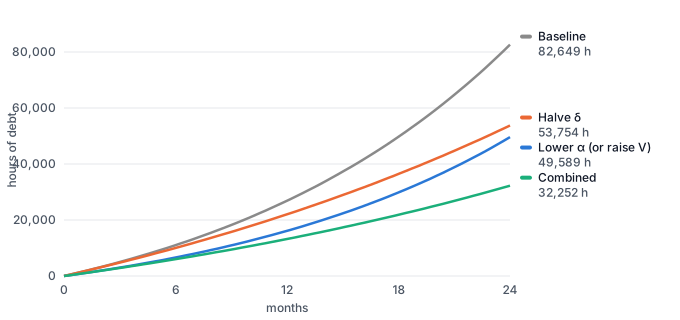
We simulated each lever with the model itself. The parameters are illustrative, not measured: 100 changes per day, 1.2 hours per change, 70 hours of verification per day and δ = 0.2% per day.
| Scenario | 30 days | 1 year | 2 years | Versus baseline |
|---|---|---|---|---|
| Baseline | 1,546 h | 26,877 h | 82,649 h | — |
| Lower α from 1.2 to 1.0 h per change | 928 h | 16,126 h | 49,589 h | −40% |
| Raise V from 70 to 90 h per day | 928 h | 16,126 h | 49,589 h | −40% |
| Lower G from 100 to 80 changes per day | 804 h | 13,976 h | 42,977 h | −48% |
| Lower δ from 0.2% to 0.1% per day | 1,523 h | 22,026 h | 53,754 h | −35% |
| Combined: α = 1.0 and δ = 0.1% | 914 h | 13,215 h | 32,252 h | −61% |
| Verify at the pace of generation (V = 120 h) | 0 h | 0 h | 0 h | −100% |
Three takeaways:
- Lowering α is as good as hiring capacity. Saving 0.2 hours per change yields the same as adding 20 hours of verification a day, and usually costs far less: smaller, better-specified PRs.
- δ barely shows after a month and dominates after two years. At 30 days, halving δ reduces the debt by less than 2%; at two years, by 35%. That is why investing in architecture looks useless in the short term and is decisive in the long term.
- Acting late costs more. To stop the debt from day zero, 120 hours of verification a day are enough. Wait a year, with 26,877 hours already accumulated, and it takes 174 hours a day, 45% more, just to stop it from growing.
Controls by change risk
| Risk | Examples | Minimum controls |
|---|---|---|
| Low | Docs, styling, prototypes, internal scripts | Automated verification; merging without human review is acceptable |
| Medium | Business features without sensitive data | Tests written before the code; PRs of 400 lines or less; agent review plus human confirmation |
| High | Authentication, personal data, money, external input | All of the above, plus line-by-line human review, a threat model with one test per threat, and gradual rollout |
| Critical | Calculation core, security, regulatory compliance | All of the above, plus two independent human approvals, formal or property-based verification, and rehearsed rollback |
An edge case: a single maintainer
We also looked at a production repository with a single maintainer and the automated controls already in place:
- Tests are written first, and a mechanism prevents the agent from editing them.
- No PR may exceed 400 lines of code.
- Full verification is mandatory before anything is marked as done.
- The agent reviews and a person approves.
- There is an approval gate before production and rollback by artifact.
In that repository, 70% of commits are co-authored by AI, and none of its 116 PRs was reviewed by another person. It is a useful case for the underlying question: do automated controls replace human review, or merely disguise its absence?
How to validate it
| Step | What is measured | What it decides |
|---|---|---|
| 1. Symptom versus harm | ρ̂ per repository versus the rate of reverts and fix PRs | Whether the thesis or rival R1 wins |
| 2. Split by risk | ρ̂ in repositories with users or dependents versus personal ones | Whether the thesis or rival R2 wins |
| 3. Common cause | Mutants surviving tests from the same AI, another AI, and tests written from the specification | H3, the most original result and the cheapest to produce |
| 4. Estimate δ | Linear versus exponential fit of debt per repository | Whether growth is really exponential |
Only with these results will it make sense to say how much to invest in each lever.
Limitations
- ρ̂ counts approvals, not hours of verification. It is a trend indicator, not a direct measure of verification capacity.
- The simulation parameters are illustrative. They show the shape of the phenomenon, not its size in a specific team.
- Public GitHub does not represent private enterprise software, where review practices tend to be stricter.
- Agents signing their PRs is optional, so real AI usage is underestimated.
- The concept of "verification debt" already exists (Sonar, 2026). What this work contributes is the formalization, the derived results and the evidence, not the term.
Sources
- GitHub Search API and GraphQL API, our own collection on October 16, 2026.
- SmartBear and Cisco Systems: a study of 2,500 code reviews. Review is effective at 200 to 400 lines per session, and detection drops above 500 lines per hour.
- DORA, State of DevOps: delivery metrics and change failure rate.
- GitHub, Octoverse: annual contribution volume.
- Sonar, What is AI code verification debt? (2026).
- Ehsani et al., TOSEM (2026); Jin and Chen (2026); Leu et al. and Nam and Yang, ESEM (2026); Cheung (2026).
Calculate your team's verification debt
Enter your team's numbers. Everything is calculated in your browser: nothing is sent or stored.
At risk: the debt becomes unsustainable in 6.7 months (203 days).
Debt at 30 days: 928 h · Debt at 1 year: 16,126 h
━ Debt · ╌ Unsustainable threshold · hours of debt
What to apply first
- You generate 120 h of verification work a day and have 90 h: 30 h a day are missing. Until you close that gap, the debt keeps growing.
- Cut the cost of verifying each change by 20%: small PRs, specification before code, strict types. With this: unsustainable in 33.1 months.
- Generate 20% fewer changes: limit work in progress. With this: unsustainable in 33.1 months.
- Add 20% of independent verification: property-based and mutation tests, static analysis. With this: unsustainable in 24.7 months.
- Keep the debt from rotting (halve δ): modularity, versioned contracts and early review. With this: unsustainable in 13.3 months.
- Write the tests before the code, and don't let the same AI that generated the code change them.
- Assign human review by risk: full review for payments, authentication and personal data; automated for the rest.