AI in education: what MIT actually says, and what the evidence shows about learning with AI
A two-page summary titled "Artificial intelligence and education: what does MIT say?" has been going around. Its central idea is sensible: AI helps learning when it supports the learner's effort and gets in the way when it replaces it. It cites six publications, with no links and not a single number.
We teach programming courses with AI, so the question is close to home, and we went to the sources. We opened the six publications and then the experiments that measure what the summary only asserts. We found three things:
- There is no single "MIT position". The six sources are very different kinds of documents: an essay by two authors, two letters, a news story, an interview, a public policy brief and a resource page for instructors.
- The central idea holds up, and the original texts are more specific and more demanding than the summary.
- The gap between support and substitute has been measured. In an experiment with about a thousand students, those who used AI without restrictions scored 48% higher in practice and 17% lower on the exam; with the same model set up as a tutor, that drop disappeared.
What the six sources really are
| Source | What it is | Date | What it adds |
|---|---|---|---|
| AI in Education, MIT Open Learning | A 13-page essay by Andrés F. Salazar-Gómez and Sanjay Sarma. "How to Think of AI in Education" is the file name, not the title | July 2025 | The underlying argument: redesign from the science of learning |
| AI and education: A watershed moment for MIT | A letter from President Sally Kornbluth, plus a second letter from the chancellor, the provost and the chair of the faculty | August 25, 2026 | They present the report of an MIT committee on AI use in teaching, learning and research training |
| Pilot to help educators teach AI across disciplines, MIT News | A story about a weeklong workshop run by the Schwarzman College of Computing | September 9, 2026 | Training instructors: 19 faculty members from 7 institutions |
| Q&A: MIT SHASS and the future of education in the age of AI, MIT News | An interview with Agustín Rayo, dean of humanities, arts and social sciences | April 14, 2026 | Which education keeps its value |
| AI Policy Brief: K-12 Education, MIT RAISE | A policy brief for the US federal government, by six authors | July 19, 2024 | Rules for K-12 education |
| Generative AI, Teaching + Learning Lab | An index page with eight links. The substance is in guides such as Generative AI & Your Course | Undated | Practical recommendations for instructors |
Three clarifications the summary leaves out. The oldest source is from 2024 and the newest from September 2026: they are not a joint statement. The interview and the news story are about what to teach, not about how AI affects learning. And both letters point to a document the summary does not list: the report of the committee MIT charged in January 2026, which we did not review for this article and which is the primary source for what the institution decided.
What they do say
1. Adding AI to what already exists is not enough. This is the thesis of the essay by Salazar-Gómez and Sarma: "Bolting AI on to outdated educational models, we argue, is not only ineffective—it may deepen existing problems." They propose starting from what is known about how people learn: scaffolding, desirable difficulties, active learning and metacognition. And they are not naive about commercial products: "Many of the AI solutions we see in the market are, frankly, high on flash but low on substance."
2. The in-person classroom matters more. The same essay calls it "the hero" of the redesign: the place for coaching, open-ended problems and teamwork, while information delivery happens elsewhere. Its conclusion about control is blunt: "the most reliable guardrails against AI misuse are not algorithmic—but human."
3. Assessment splits in two. Outside class, formative and open assessments with AI allowed. For grading, in-person or proctored assessments. The Teaching + Learning Lab adds assessing the process as well as the product, with an argument that is hard to dispute: "it is much more difficult for students to explain their problem-solving process when they didn't actually solve the problem!"
4. Every class states its AI policy, visibly and with its reasons, from day one. Kornbluth's letter asks for this along with a renewed emphasis on hands-on learning, and sums up the goal: to prepare students "to know when and how to use AI effectively, wisely, ethically, and responsibly, and when not to use it at all."
5. Do not use AI detectors. Two sources say so independently. The RAISE brief suggests teachers not rely on them because of their high rate of false positives, and the Teaching + Learning Lab "strongly recommends against" them.
6. Neither ban AI nor replace teachers. The RAISE brief rejects broad bans and also the hype: "AI is not a magical elixir that can be added to education with guaranteed positive results," and it "should be used to enhance teaching, not to reduce the number of teachers."
7. What is scarce is prepared educators. The Schwarzman College pilot starts from the premise that quality material is abundant and what is missing is faculty able to teach AI within their own field, so that students learn to question models and not just apply them. Rayo goes further: students must be able to execute tasks and also have "the judgment to determine which tasks are worth executing."
The "your brain on ChatGPT" study
The summary warns that the risks do not prove AI reduces "brain activity". The phrase points to an MIT Media Lab paper that is not on its list and made headlines in 2025: Your Brain on ChatGPT, by Kosmyna and colleagues.
It helps to know what it is. It is a preprint that has not been peer reviewed. Fifty-four people wrote essays with ChatGPT, with a search engine or with no help while their brain activity was recorded with EEG; only 18 completed the fourth session. The authors describe weaker connectivity in the ChatGPT group and more difficulty quoting their own essay.
The same authors publish a list of what they ask people not to conclude from their work, which includes "harm", "brain damage" and "LLMs make you stop thinking", and they ask for the results to be treated as preliminary. A critical commentary by other researchers, also not peer reviewed, estimates the sample should have been about 159 people and points out reporting inconsistencies.
It is a lead worth investigating. It is not evidence that AI damages the brain, and an article that presents it that way is saying more than its authors do.
What the measured evidence says
| Study | Design | What it says | What it does not say |
|---|---|---|---|
| Bastani et al., PNAS, 2025 | Randomized experiment with about 1,000 high school students in Turkey, in math | With a ChatGPT-style interface they did 48% better in practice and scored 17% lower on the unassisted exam. With a tutor with guardrails, 127% better in practice and no difference on the exam | That the tutor teaches more than using no AI: it prevented the harm, it did not beat the control group. Nor what happens in the long run |
| Kestin et al., Scientific Reports, 2025 | Crossover experiment with 194 physics students at Harvard | With an AI tutor built on pedagogical principles, the median post-test score was 4.5 versus 3.5 in an active learning class, in 49 minutes versus 60 | That a generic chatbot teaches better than a professor: the tutor relied on verified solutions and months of work. Two lessons, immediate test |
| Shen and Tamkin, Anthropic, 2026 | Randomized experiment with 52 programmers learning a new library. Preprint | Those with an AI assistant scored 50% on the comprehension quiz versus 67% for those without, with no significant time savings. The largest gap was in debugging | Long-term effects: it is a one-hour task |
| Lee et al., Microsoft Research and Carnegie Mellon, CHI, 2025 | Survey of 319 knowledge workers, with 936 examples of use | More confidence in AI goes with less reported critical thinking; more self-confidence goes with more | Causation: the authors say so explicitly. It is self-reported |
| Roediger and Karpicke, Psychological Science, 2006 | Memory experiments with college students | A week later, those who tested themselves recalled 61% versus 40% for those who only reread, even though the rereaders felt more confident | Anything about AI: it is the basis for why the effort of recalling matters |
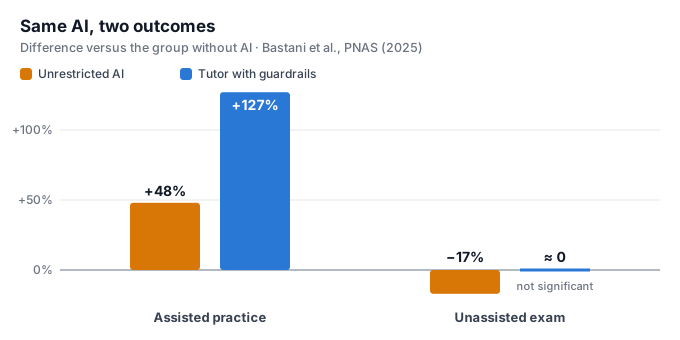
The Bastani experiment isolates the question best. All three groups followed the same sequence: teacher review, practice and a closed-book exam. What changed was what they had at hand during practice: the textbook, the open interface or the tutor. With the open interface, students asked for the solution and copied it. The tutor was instructed to give minimal hints, ask for the student's work first and never hand over the full solution, and it carried the correct answer and the common mistakes for each problem, written by teachers.
One detail is more uncomfortable than the 17% drop: those who did worse did not perceive that they had learned less. It matches the 2006 finding: rereading feels safer than testing yourself and leaves less memory behind. The feeling of progress is not a measure of progress.
Same assistant, six ways to use it
The Anthropic study is the closest to what we do, because it measures people who write code. Within the AI group, the authors classified how each person used it:
| Usage pattern | People | Comprehension quiz |
|---|---|---|
| Generate the code, then ask for it to be explained | 2 | 86% |
| Ask for code with an explanation | 3 | 68% |
| Ask only conceptual questions and write the code themselves | 7 | 65% |
| Delegate everything | 4 | 39% |
| Start on their own and end up delegating | 4 | 35% |
| Debug by asking the AI to fix each error | 4 | 24% |
The first three patterns landed close to the 67% of the group without AI; the last three, far below. These are groups of two to seven people and the analysis is observational: it shows where to look, it does not prove that the pattern causes the result. But the direction matches Bastani's: what separates people is not whether they use AI, but who does the work of understanding.
What we do with this
If you are learning to program:
- Try before you ask. The first attempt, even a failed one, is the part you retain.
- Ask for hints and explanations, not solutions. That is the difference between the two arms of the Bastani experiment.
- Debug on your own before pasting the error into the chat. It is the pattern with the worst result in the Anthropic study, and debugging is exactly what you need in order to review generated code.
- Test yourself without the tool. If you cannot explain it or rewrite it unaided, you have not learned it yet.
If you teach or design a course:
- State the AI policy for each activity, and the reason for it.
- Separate practice from grading: open practice with AI, assessment without it.
- Assess the process: ask for the reasoning, the assumptions and the dead ends.
- Do not use AI detectors.
- If you offer an AI tutor, design it: with the solutions and common mistakes written by the instructor, and with the instruction not to give the answer away. In both experiments where it worked, the authors describe that design as laborious.
For a company training its people, the consequence is the one we described in The broken pipeline: finishing a task with AI does not mean having learned to do it, and the judgment needed to audit what AI generates comes from having done the work of understanding. What that implies for curricula is in Teaching software engineering when AI writes the code.
What is measured and what is not
| Claim | Status |
|---|---|
| Using AI to get the answer improves practice and worsens later performance without it | Measured in the short term, in high school math |
| An AI tutor with guardrails prevents that harm | Measured in the same experiment |
| A well-designed AI tutor can beat a good class | Measured in one course, two lessons, with an immediate test |
| Learning a programming tool with an assistant reduces immediate comprehension | Measured in a small experiment, not yet peer reviewed |
| People learning with AI do not notice they are learning less | Measured in the Bastani experiment |
| AI reduces brain activity or damages the brain | Not shown: a 54-person preprint whose authors ask people not to conclude it |
| The effects last months or years | Not measured: every study is short term |
What this article does not claim
- It does not claim MIT has a single position. These are six documents with different authors, dates and purposes, and the summary itself acknowledges it.
- It does not claim AI is bad for learning. The same experiments show that, designed as a tutor, it does no harm and can help.
- It does not claim the results carry over to any age, subject or tool. They come from high school math, college physics and a one-hour programming task.
- We did not review the MIT committee report the letters point to; what we say about it comes from the letters that present it.
- It does not cite figures we could not check in the original source, however widely they circulate.
Sources
MIT publications, accessed November 15, 2026:
- Salazar-Gómez and Sarma, AI in Education, MIT Open Learning, July 2025 (version 2, October 2025).
- Kornbluth, AI and education: A watershed moment for MIT, August 25, 2026; on the same page, a letter from Nobles, Chandrakasan and Levy.
- Diehl, MIT Schwarzman College of Computing launches pilot to help educators teach AI across disciplines, MIT News, September 9, 2026.
- Q&A: MIT SHASS and the future of education in the age of AI, MIT News, April 14, 2026.
- DiPaola, Salazar-Gómez, Abelson, Klopfer, Goldston and Breazeal, AI Policy Brief: K-12 Education, MIT RAISE, July 19, 2024.
- MIT Teaching + Learning Lab, Generative AI and Generative AI & Your Course.
Studies:
- Bastani et al., Generative AI without guardrails can harm learning: Evidence from high school mathematics, PNAS 122(26), e2422633122 (2025). doi:10.1073/pnas.2422633122
- Kestin et al., AI tutoring outperforms in-class active learning, Scientific Reports 15, 17458 (2025). doi:10.1038/s41598-025-97652-6
- Shen and Tamkin, How AI Impacts Skill Formation, arXiv:2601.20245 (2026), preprint.
- Lee et al., The Impact of Generative AI on Critical Thinking, CHI '25. doi:10.1145/3706598.3713778
- Roediger and Karpicke, Test-enhanced learning: Taking memory tests improves long-term retention, Psychological Science 17(3), 249–255 (2006).
- Kosmyna et al., Your Brain on ChatGPT, arXiv:2506.08872 (2025), preprint; the authors' limitations and FAQ at brainonllm.com.
- Stanković et al., commentary on Kosmyna et al., arXiv:2601.00856, preprint.
- Dixi-Project: The broken pipeline and Teaching software engineering when AI writes the code (2026).